The Benefits of Hiring International Candidates for Shortage Occupations

The UK’s Shortage Occupation List (SOL) was amended on 6 October 2019 to include a number of new occupations.

UK Restaurant Owners & culinary companies will also welcome these changes given they can now hire skilled chefs (SOC code 5434) into their kitchens even if their business is providing a takeaway service. Other key occupations added to the list include all civil engineering roles (SOC code 2121) and architects (SOC code 2431).

The list also now includes a number of new (or expanded) Standard Occupational Classification (SOC) codes including the following widely used digital and IT occupations:

  • All IT business analysts, architects and system designer roles SOC code 2135
  • All programme and software development roles SOC code 2136
  • All web design and development professional roles SOC code 2137
  • Cyber security specialists classified under SOC code 2139

Companies seeking to sponsor a non-EEA national into a ‘shortage’ role, will find the Tier 2 rules are a lot less stringent. Namely:

  • Exemption from the Resident Labour Market Test (‘RLMT’)– The ‘shortage’ vacancy does not need to be advertised by your organisation.
  • Exception on attaining salary level– A ‘shortage’ worker is not obliged to meet the minimum earnings threshold when applying for Permanent Residence.
  • Lower costs– The government applies reduced Tier 2 application fees in relation to those occupations listed on the shortage list.
  • Priority allocation– Roles on the shortage occupation list are awarded priority allocation when the ‘cap’ on the monthly allocation of certificates of sponsorship is reached.

This mean international students & professionals who are applying to work in the UK, have a much higher chance in being sponsored for a SOL job due to the above benefits.

Reference: https://smithstonewalters.com/2019/10/08/update-tier-2-shortage-occupation-list/

The Top Jobs You Should Apply to If you Want to Get Tier-2 Visa Sponsorship in the UK.

Whether you are an International student in the UK or an experienced professional abroad who are interested in finding work in the UK which provides you with Visa Sponsorship.

There is ONE question you need to ask yourself. 

Is the job you are applying for on the Shortage Occupation List (SOL)?

You may be asking what the hell is the SOL? well it’s a list of roles that UK companies have hard time finding people to fill, hence the government has given less restrictions on these jobs for companies in order to be able to sponsor professionals from abroad for these jobs.

The SOL contains many fields which you can pick from, which will give you a good chance in getting sponsored, because it offers a lot of flexibility for employers to be able to sponsor on Tier 2 visa. Read more about the benefits of the SOL here.

If you are an international student, your only option is to look for a job which is on the Shortage Occupation List, you need to have finished your degree, and previously obtained some experience in the relevant domain.

If you are interested in studying in the UK the same rules apply, you just have to pick a job from the SOL & study a university degree relevant to it.

If you are a professional living abroad and looking to relocate to the UK, You need between 3 to 7 years of experience in a field which is also listed on the Shortage Occupation List (SOL).

Why does it have to be a SOL job?

Your other question might be, why do I need to pick something from the SOL? why can’t I just apply to the jobs I have experience with. Well if you are coming from abroad and you need to find a job in the UK, you need to have the best chance in getting sponsored.

Because these jobs are the most in demand in the UK right now, this means companies are 80% more likely to sponsor you for this role than any other role which is not on the SOL!

Here are some fields which ARE NOT on the SOL:

Business Management, 
Project Management
Marketing. 
Accounting & Finance.  
Customer Service

These jobs are not in demand in the UK because there are enough nationals & EU citizens who can do those jobs, so you have a very low chance of being able to get sponsorship for these areas, I DON’T recommend you study these programmes in university if your plan is to find work in the UK!

If you want to get an edge & beat the competition in the job market, you need to pick something from the SOL.

What if my target job is not on the SOL and I am already studying one of the above subject?

Targeting a job on the SOL will give you the highest chance in getting sponsored, but I do understand there are many students who don’t have technical skills.

For this I wrote an article to highlight a few non technical jobs which you can target.

If you want to know what SoC to target but also make sure the job you are applying to qualifies for sponsorship, You need to look the Codes of practice for skilled work – Immigration Rules document and pick a job which is RQF Level 6 and above.

Resources:

UK Shortage Occupation List

Codes of practice for skilled work – Immigration Rules

If this is all gibberish to you and none of it makes sense, get in touch today.

Advice For those Struggling to Get a Job with Visa Sponsorship in the UK from Someone who had too Many.

When I was applying for sponsoring jobs, one of the companies had offered me a role at £25k with visa sponsorship,  

The story I don’t usually tell is that I actually turned down that offer, because I knew I could get something better, which I did.  

But I wasn’t always that confident, actually it was a real struggle for me to get that job offer in the first place, But I did it, and I knew I could do it all over again, how?  

Because I knew what was in demand in the job market, I knew where the market need is and I jumped right into the thick of that. 

The biggest mistake jobs seeking International students make is not doing the research on what degrees will open the door for them to get hired,  

That’s not entirely their fault alone, there’s little to no guidance at all from universities to people around getting into market driven educational programmes,  

But this has rather turned into a money making venture for educational institutions, where it’s only optimising for more recruited students, and not really whatever the f* happens with them after graduating.  

This means it’s now on the student to do their own homework, because there’s 10s of thousands & years at stake here.  

Let alone the pain & hassle of your visa expiring, going back and looking for other ways to get back into the UK job market.  

Always look for what’s in demand in the market, and I will tell you right now:  

It’s not Business Management, 
It’s not  Marketing. 
& sure as hell it’s not Accounting & Finance.  

All things technical like engineering, programming, development & IT. These are what’s really in demand,  

And none of that other stuff where for each international student you can find 10 nationals who have studied it and can do it better!  

For more info on what are the most in demand jobs in the UK right now which give you the highest chance at getting hired, checkout the Government’s shortage occupation list here:

UK Shortage Occupation List

To your success! 

From School Teacher to Software Developer in 12 Weeks

When Shahrukh started working with me, he had been a school teacher for over 2 years.

He had some previous experience working with a dev team but never been a dev before, although he studied it in uni.

He wasn’t really sure how to get into the industry, especially with all the options out there.

But he knew he had to work on himself and change his career!

We worked together on building this small project, to help him understand the very basics of web development.

We didn’t build a portfolio, we didn’t have 10 projects on that portfolio.

All we had is a good understanding of what companies are looking for in a junior developer:

* Basic knowledge is the domain of the job you’re applying to.

* A can-do attitude which shows your willingness to learn quickly & ability solve problems.

* Being a good cultural fit by integrating & collaborate well with the team.

In addition to prepping for interviews & technical questions, that’s really all we did.

We started booking him on interviews very quickly after finishing the technical prep.

And that’s how he managed to secure an amazing offer with a great salary as a Junior Web Developer.

He is now on track for an amazing career in Web Development!

Congratulations Shahrukh!

a group of people sitting at a table posing for the camera, drinks, food, jay sabra

#career #jobs #results #success

What Programming Language or Framework Should I Pursue for a Successful Career in Software Engineering?

I often get asked what tech stack, programming language or framework should I learn to get the best chance at being hired?

Whether you are a self educated dev wanna be or international graduate looking for a job in the UK.

You’ll get presented with 10s of different tech or suggestions from friends or others to pursue, especially when there’s a new framework coming every other day for some technologies.

So how do you know what to pick in order to get the best chance in getting hired?

Your chances in getting hired are directly related to what is most in demand in the job market.

Web Development & Data Science are the hottest jobs in the UK right now.

And this isn’t according to Glassdoor because they also think Accounting is up there with these skills on the demand ladder.

That’s not accurate and it’s probably based on the number of roles listed on their site, but really, demand isn’t only reflected by the number of jobs posted.

It’s also represented by how much trouble companies are willing to go through to hire someone with such skills. This can be in two forms:

  • How much money they’re willing to pay (salary/day rate)
  • If they are willing to provide visa sponsorship for this role.

If you disagree, try getting a visa sponsorship for an accounting role or get paid £500 per day to that job.

Within Web development, There are thousands of projects kick starting across companies of different sizes.

Many of which are undergoing digital transformation, to keep up with the fast paced shifts & changes in their markets.

This has generated a lot of variation in tech stacks used & there’s a new framework coming out every day.

Here are some tips to help you stay up to date & make the right decision.

Front End

If you are front end person, and would love to work with the look and feel of websites or products,

HTML, CSS, & JavaScript are a must have for any web developer, then you can focus on JS, particularly the React library, also playing with node.js & MongoDB can certainly complement your knowledge.

Back End

If you are into backend, you like working more with inner workings of software, API’s and integrations across applications, but also have a light touch on the front end, you can always learn C# & .NET.

This combined with some hands on exposure to some of the enterprise level management applications out there like Sitecore or Umbraco will be a sure-fire way to get into a job very quickly.

In general a full stack knowledge of developing web applications is certainly invaluable to have in this market.

Data Science

Python would be your go to if you like working with data & solve market problems through processing data & extracting insights.

DevOps

Is another area which is highly in demand if you like working with tools & infrastructure, leveraging knowledge in Cloud tech like Azure, AWS & Google Cloud Platform (GCP) this also requires knowledge of scripting languages like Power Shell & Containerisation tools like Docker & Kubernetes.

So there’s are a few options to choose from, your mission is to just match your interests & skills to one of the above areas that are in demand in the market!

To your Success

From Loss & Confusion in Lebanon to Getting a job with Tier 2 Sponsorship in the UK.

I arrived in the UK in feb 2013. It was uncharted territory for me. 

First time for me in the UK, and first time I ever travel out of my country, Lebanon. 

I had the advantage of having good command of English, but that’s pretty much all I had. 

The plan was to study a master’s degree here, and then see how things go afterwards. 

because back in Lebanon, there wasn’t a lot of prospects for me. 

Even if you are a highly qualified and learned individual, your chances of starting a fruitful career are quite slim. 

Nearing the end of my degree, I was still unsure what to do, 

Especially with all the pressure that I had, 

Working night shift as a hotel receptionist, studying & preparing for my dissertation. 

I really had very little head-space to think about what I am going to do next after my studies. 

But the thing is, I was running out of time, 

So kicked in full throttle, because going back to Lebanon was not an option. 

I made it my sole goal to land a job here in the UK with Visa sponsorship. 

I started doing a lot of research into the Tier 2 sponsorship process. 

What are the roles qualified, what are the requirements, how long it takes etc.. 

I spent hundreds of hours filtering through a list of 30,000 companies trying to find the ones which could potentially hire me. 

I realised although I had some experience working in IT but still companies were asking for more. 

the good ol’ commercial working experience wasn’t really enough. 

It had to be in something specific, something niche. 

I managed to get some hands on work with C# development. 

And to top it off I worked on developing components for a niche enterprise level CMS. 

At that point this was a perfect example of a niche skill set that could give me the best chance at getting sponsored. 

Eventually all I really had was 4 weeks’ worth of actual development experience. 

But experience in a high demand niche. 

That’s what made it possible for me to land my first offer for a job with visa sponsorship. 

So in summary, what I needed to achieve this are three things: 

  1. Some working experience. 
  2. Knowledge of niche technology that is in demand. 
  3. Resilience, a can do attitude, and never giving up. 

Today I am helping others achieve the same through learning niche skill sets in web or software development through my 5 years’ experience in this space. 

Free Resume Template

Your CV is the first representation employers will look at when they’re considering you for a role.

It’s the key which opens up the door for you to the opportunity you’re after.

If this key is broken, you’ll get locked out and get rejections.

AND there’s no number of doors you can try that will make this broken key work!

So stop asking for company connections & MORE job opportunities, and start thinking about the quality of your CV.

There are literally hundreds of ways you can connect with people & get access to thousands of opportunities.

But if somehow you still struggle to find a job or an employer that will provide you with visa sponsorship.

This means your issue is not a numbers problem, it’s a quality problem.

The quality of your CV, and your LinkedIn profile, and the way you are presenting yourself to these companies.

That’s what’s not working out for you.

The three key highlights your CV & profile need to have are:

  • Be compatible with the UK job market & formatted as such.
  • Be targeting a niche skill or a high demand job in the UK.
  • Show your relevant experience as well as highlight the role you are applying to!

Having these is your only chance in being able to stand out among some thousands of applicants for each role.

Below is a Free CV template which I included to help you get an idea of what structure, grammar & tone to use to make your CV stand out.

Thinking of Going for Another Degree? DON’T. Here’s Why

Education & Training are useless.  

Study 5 years in Uni, & spend £50k, then start looking for a job.  

That doesn’t work, so your first answer to this is do more education?  

Ok hold on, let me just get this straight.  

You have already spent all this time and money on education, and what did it get you?  

Did it get you a job? No  

Did it give you the confidence to get a job? No  

Did it give you market driven skills & knowledge to start in industry and plan for a successful career? No  

All you had is that piece of paper that is your degree.  

So your plan now is to get more pieces of paper? Certifications? Qualifications?  

What is this? Gotta catchem all for useless pieces of paper?  

Let’s get ONE thing straight. 

If you keep doing more of the same you will get exactly the same results! 

And you going for more qualification & training certifications, are just mini aftershocks similar to the main quake that is your university degree, so how can you expect a different result?  

Where did all the education you’ve done get you? To a place of confusion, being lost, and being in pain.  

Not sure what jobs to go for, not sure how to find & apply for jobs which are relevant to you and easy for you to enter.  

So how do you change your approach to get different results?  

How do you end this pain festered confusion & get clarity on how to get your first job and start a decent career?  

Get market driven education with real world experience, tangible results & skills, not just a degree or certification.  

Get education of which the outcome is getting the actual job, not the piece of paper!  

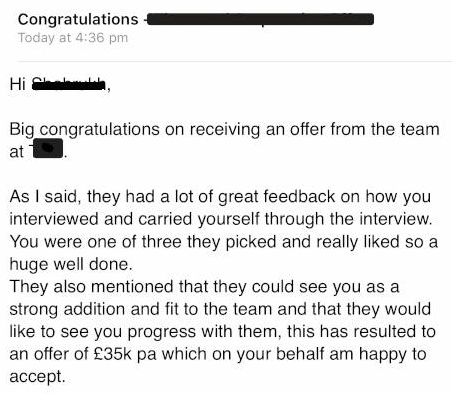
From Knowing Nothing about Web Development to Software Engineer at £35k within 8 Weeks.

Four months before I finished university, I had started looking for job to make some money.

I wanted to be independent, I thought to myself, “Now I have two university degrees, I ought be able to get a job and become financially solid.” But boy was I wrong!

Little did I know that university degrees is the last thing companies will look at on my CV. Sure, it is very nice to have, so was I told by the many recruiters I’ve spoken to.

They all said: “hey It’s pretty cool you have a Masters degree in this”, “oh you went to this university, that’s great!”.

Well, does any of that get me a job? Nope.

Small companies, big companies, IT, other industries and sectors, You name it, I have went online and in store to apply for these jobs and it was refusal after another.

I have spent at least 4 hours of every day applying to jobs non-stop, I knew very little about the world of job hunting and I started to realise I needed a change of approach.

To me it was do or die, survival mode on. Because my parents had spent all the cash they had to help me through the university studies, and I wanted to be able to at least pay for my own living expenses.

I just needed to find any job, I don’t care if it’s relevant to what I just spent 5 years in Uni studying. As long as it gave me the level of income I needed.

Running really low on the things I could do, there were a last couple of things I thought I’d try.

One of those things was close to finishing my dissertation project, which was a web app which I thought could be helpful for fellow students in university. It was a very raw prototype which throws plain text directions for students when they input a number of a classroom.

So I thought I’d run it by the Dean of engineering at the time, see if the university could actually benefit from this or develop it into something bigger.

I didn’t make much of this conversation when we first met, because he was going on and on about aerospace and aviation engineering, shit which I’ve had nor the interest neither the knowledge in.

But it was this very conversation that put me on his radar, kept me on top of mind when the Web Manager in IT services had gotten in touch.

The web team had been looking for someone to come on-board and help out with some testing for the website, and they were desperately looking for someone to start asap.

I was sitting somewhere in Reading in a park with a friend. When my phone rang. And that’s how it all got started.

When he first told me about the role, i was scared and hesitant, I was telling myself all kinds of stuff: “I don’t even know what web testing is”, “I have no prior experience working with a team”, and “what the fuck is a browser matrix?!”.

I was panicking, but at the same time I needed that job and I needed that money.

And that’s how it happened, Monday the 28th of July was my first day working as a temp tester.

It was then when my manager saw the interest and hunger I had and gave me that 2 week project, which allowed me to join the development team for 2 months and that’s what opened the door for me to get my first job shortly after at £35k.

The real takeaway from this is all you have to do is start small, the most important thing is to start close to where you want to be.

Build a tent next to the mountain you want to climb, then start step by step, and build on the momentum of the small achievements that you’ve made.

Did i know the start of my career was going to be in testing? No. Have I ever thought that to get into a development role I’d have to work in different roles within IT such as support & QA, surely not.

But starting in that temp job has opened the door for me into many different opportunities and routes, I could have been a support manager, or a technical PM, or even a QA team manager.

But I chose development because It was the most interesting at the time.

And here I am today less than 4 years later in a technical consulting role making more than triple what I earned in my first temp job. All thanks to THAT first job.

If you would like to learn more and have the same transformation in your career, drop me a line and let’s have a free strategy session today!

Get in touch
Experience Matters? Nope. The Biggest Myth In the Talent Space Right Now.

There seems to be a split in views right now around experience and how hiring companies and recruiters approach this when looking for talent. 

The number of years of experience is something many recruiters get stuck on and they obsess about when looking for candidates.  

I know this because I’ve been on the candidate end of the scope and have been judged if fit for roles using this very (questionable) metric.  

I can’t start to imagine how many excellent candidates get denied the opportunity to bring real value to businesses just because they didn’t tick the box, or missed this number by 1 years. 

This is the biggest myth in the talent world right now. 

In business often those who are outsiders to a market or industry are the ones who irreversibly disrupt that market.  

Jeff Bezos didn’t have 11 years of experience in the commerce space when he started Amazon, Mark z. wasn’t a social media manager for 25 years in some digital agency when he started Facebook.. 

The same applies in the talent world, there no guarantee someone with 10 years experience will give you insights & innovation that’ll help move your business quicker towards your goals.  

In fact, research shows that people with a greater number of years in experience are less likely to be innovative & creative in their approach to problem solving.  

I’m not saying you should hire a monkey and put it in charge. But what am I really saying? 

Smart companies look for smart people, talented individuals, but what is really the meaning of a talented individual (buzzwords & fads aside) and what exactly does it mean to these smart companies?  

These companies look for THREE qualities in any person applying for a job, particularly in the software engineering space. Passion & motivation, Being quick learner who can solve problems creatively & Being a hard worker.  

That’s all you need to make the company sure you can pull off whatever job they have at hand, and demonstrating these qualities to the hiring company will be your sure fire way of acing that interview!  

There are exceptions to this rule of course, there are some jobs out there that definitely require real life experience & training, such as flying a plane or controlling a rocket!  

But surely being obsessed about experience when looking for software engineers the way recruiters and some companies are right now is madness, it ain’t rocket science!